Dr. Fahd bin Abdullah Al-Zamel, Dean of the College of Medicine at King Saud University, and the supervisor of university hospitals yesterday sponsored the opening ceremony of the activities of the “first awareness day to treat hearing problems and cochlear implantation” at the King Abdulaziz Historical Center in Riyadh in the presence of Dr. Abdul Rahman bin Abdullah Hajar, Director of the King Abdullah Specialist Center for Ear Who pointed out that this day is a unique event of its kind in the Kingdom, and it will become annually an awareness day for all segments of society with diseases and hearing problems and electronic cochlear implantation, and he said that hearing problems in the Kingdom are witnessing a continuous increase and the rates of hearing diseases in Kingdom of superiority of global proportions, pointing out that the world average does not exceed one per thousand, but it goes beyond that in the kingdom because of inbreeding.
Dr. Hajar pointed out that the Kingdom currently needs to grow 1,000 electronic cochlears annually to treat patients from hearing and deafness problems, noting that in 2008 the number of patients who underwent electronic cochlear implantation reached nearly 60 patients, and after five years the center now provides 400 electronic cochlear Annually, this puts the King Abdullah Specialist Center for Ear as the largest cochlear implant center in the Middle East, pointing out that the center prepares previous patients for hearing and deafness as ambassadors to attract more patients and persuade them to perform surgery and rehabilitation to be healthy.
The Director of the King Abdullah Specialist Center for Ear stated that the King Abdullah Specialist Center for Ear was established in 2012 to be the first reference in raising awareness about hearing disability and its treatment methods, and works to provide training services for doctors and specialists from Saudi cadres, explaining that approval to establish the King Abdullah Specialist Center for Ear at King University Saud came as an extension of his continuous support to the higher education sector in general and to King Saud University in particular, and his initiatives for everything that would advance in this vital sector.
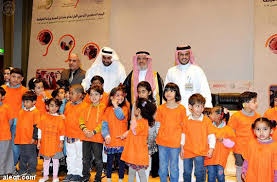
Honoring 30 children and their families who successfully passed the treatment stages as “ambassadors” of others
Dr. Hajar added that this center is the first of its kind in the field of hearing disability and headphones cultivation in the Kingdom and in the region in general, and it will be the first reference in raising awareness about hearing disability and its treatment methods, as it will provide training services for doctors, specialists and a number of national cadres to provide the best medical services For patients, this center is a research, training and treatment center in the field of hearing disability and headphones transplantation.
Dr. Hajar continued: “Given the advanced and growing level of the scientific and research movement at King Saud University, and the global qualification of its employees in the field of hearing disability, we can say that the university is the ideal and integrated incubator for this center. The university includes a group of faculty members who have international scientific degrees in the field of Hearing disability and its treatment methods, and it also includes fellowships doctors in ENT diseases, and it is the largest and oldest fellowship in the Kingdom in this specialty.
He added: “The university includes fellowships doctors in the subspecialty in ear diseases, and it is the first and only fellowship in the Middle East in this specialization, and these specialized cadres support other distinguished cadres in the field of speech and audiology, which is a specialization within the specialty of this center, in addition to all these factors Supporting the success of this center, it is located within the university’s research chairs program. An active and distinguished chair is the Research Chair for Hearing Impairment and Headphones Transplantation, who will be an active partner of the center, and support for its successes and research, and enriching its experiences and experiences. ”
Prof. Fahd bin Abdullah Al-Zamil, Dean of the College of Medicine at King Saud University, gave a comprehensive presentation on the occasion of the electronic cochlear implantation and its importance in treating hearing problems in light of the continuous growth in the Kingdom, and reviewed the active role of King Saud University in raising awareness and treatment of hearing problems in the Kingdom And the importance of research and scientific studies and rehabilitation in this regard to address hearing impairment in the Kingdom.
The activities of the first awareness of hearing problems and cochlear implantation witnessed live encounters with patients who were cured after undergoing cochlear implant surgery and rehabilitation processes to benefit from their experiences as ambassadors of patients who have not undergone treatment yet under the establishment or establishment of the Cochlear Implant Patients Association, and honored distinguished children and committed parents The rehabilitation stages after conducting cochlear implant surgery, where more than 30 families from different regions in the Kingdom (Abha – Hail – Al Qassim – Riyadh – Eastern – Jeddah – Jizan) attended, where children and their families will be distinguished by following the instructions and applying the rehabilitation programs Therapeutic Mechanism in their homes, which helped Thassanhm quickly ..
While on the occasion, the “Ranan” program was closely identified as a computer program for auditory and verbal rehabilitation for children who had a cochlear implanted, as the program trains the child in awareness and auditory awareness skills and the skills of identifying different sounds and vocabulary and distinguishing between them while acquiring the spoken language in the local environment Where the resonator targets children with cochlear implants from the age of 3 years to the age of 12 years, which are age groups that differ in their cognitive and motor skills and differ in their scientific, cultural and technical background, therefore age in this category is not a criterion for a child’s ability to use the A program and benefit from its services. Through experiments, we found that a 3-year-old child may provide better performance and benefit more from the program from an 8-year-old in accordance with various criteria.